Every day, without noticing, you ask yourself the same handful of questions on repeat. They aren't neutral, they're instructions. And your brain follows them literally.
What's actually happening
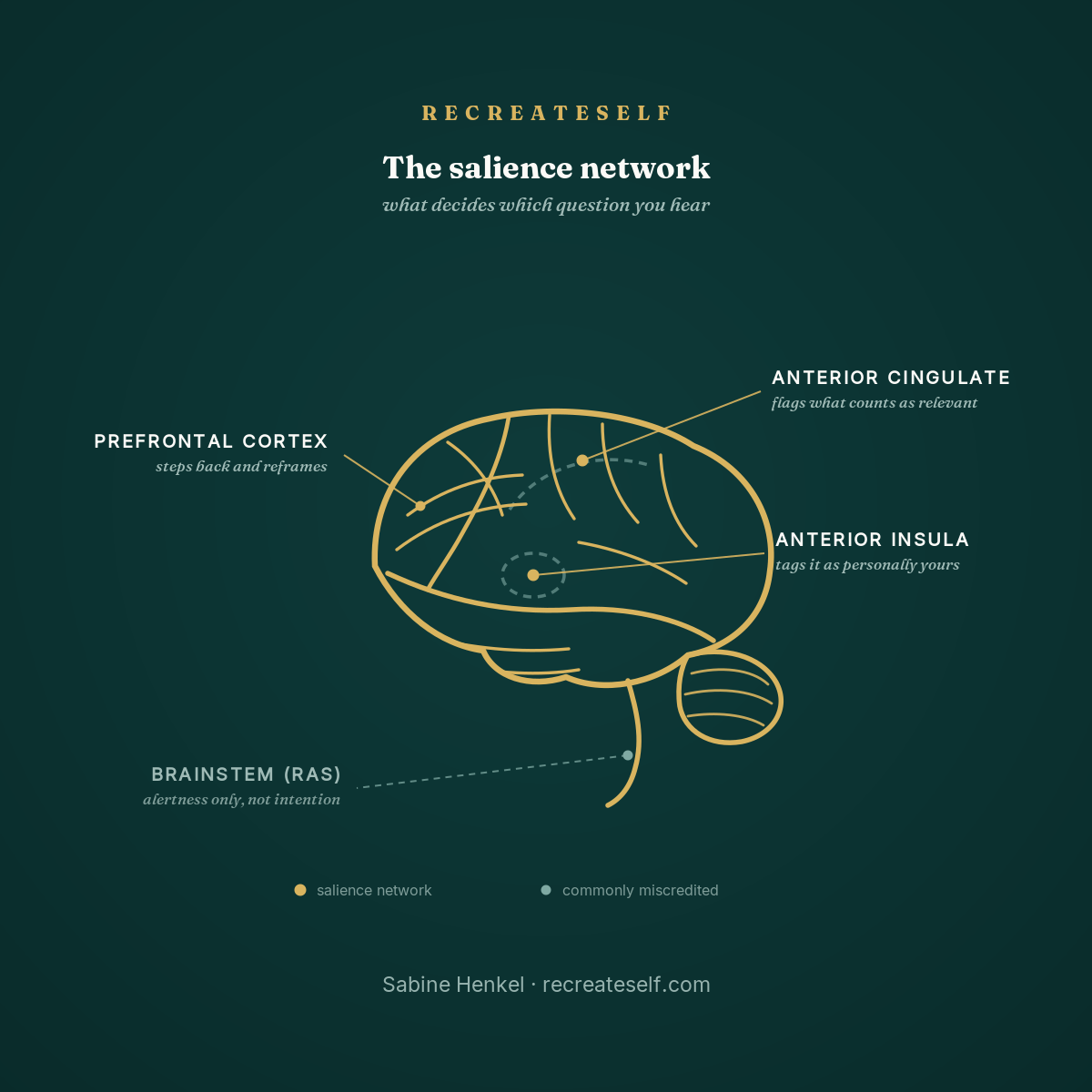
Your attention can only process a fraction of what's in front of you at any moment, so something has to decide what counts as relevant right now. Most coaching material credits this to the "Reticular Activating System" (RAS), a brainstem structure said to filter reality toward your goals. That's a popular oversimplification: the RAS is a basic alertness switch, not something built to interpret intentions. The better-supported answer is your brain's salience network, centred in the anterior insula and cingulate cortex, which flags personally significant information and pulls your attention toward it.
Layer in classic confirmation-bias research and the picture sharpens further: once you're primed with a question or an expectation, you preferentially notice, encode, and recall whatever matches it. Ask "why does this always happen to me?" and that machinery goes looking for evidence to support a case already decided. Ask "what's actually true here, and what can I do about it?" and the same machinery, aimed at the same situation, comes back with entirely different material. Same practical effect, what you focus on you find more of, just a more honest account of why.
It shows up in the body, too
In controlled studies, people who replayed a hard experience by stepping back from it, asking "what happened" rather than reliving "why did this happen to me", showed measurably lower blood-pressure reactivity in the moment, and fewer intrusive thoughts a week later. Same event, different question, different body. Researchers who study how people move toward solutions have found the same pattern: asking about the exception to a problem, or the moment it was already slightly less true, moves someone toward a fix faster than asking about the problem itself. Different question, different outcome, every time.
The pattern is already running
Most of us default to a small set of questions we never consciously chose, inherited from childhood, an old boss, a single bad year, and then run every new situation through them.
And the question changes everything downstream of it: what you notice, how you feel, what you do next.
You're already asking yourself questions all day, whether or not you chose them on purpose. The work is noticing which ones are running the show, and deciding, deliberately, which ones deserve the job. That's most of what coaching actually is: learning to ask yourself a better question, on purpose, at the moment it matters.
Time to ask better questions €80 · 30 min
Thirty minutes, one real question at a time. We take whatever you're circling, a pattern, a habit, a decision that keeps repeating, and find the better question underneath it. You'll leave with a sharper question than you arrived with, and often the start of an answer too.
Not ready to book? I am writing a short book on exactly this, why the questions we inherit outlast the situations that created them, and what it takes to choose different ones. Leave your email and I will send it to you when it is ready.
Also read: Your retreat didn't fail. You just missed the window. · The retreat isn't the transformation. What you do the Monday after is. · See all insights
Sources
Selective attention and confirmation bias, Current Biology (2019) · self-distancing and stress reactivity, Ayduk & Kross (2010) · solution-focused versus problem-focused questioning, Journal of Family Therapy (2021) and Frontiers in Psychiatry (2023).