The latest State of Menopause survey (Bonafide's sixth) had one finding that stopped me.
For years the conversation has been about the body. The hot flushes, the broken sleep, the weight that shifts overnight. This year women said something different.
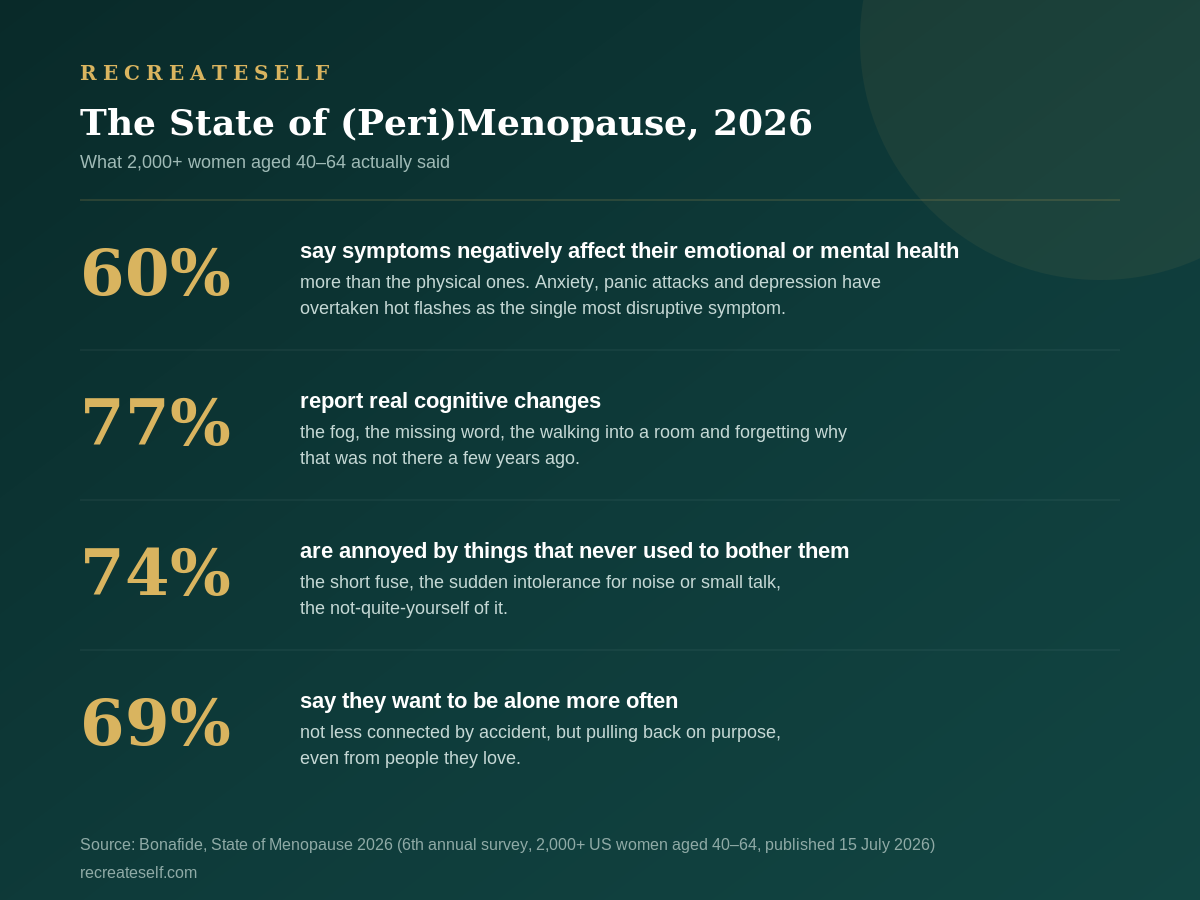
60% say the emotional and mental toll of their symptoms now outweighs the physical ones, and anxiety, panic attacks and depression have overtaken hot flashes as the single most disruptive symptom. It gets sharper in the years right before menopause, rising to 65% in women 40 to 49. 77% notice real cognitive changes, the fog, the missing word, the walking into a room and forgetting why, that was not there a few years ago. 74% find themselves annoyed by things that never used to bother them, the short fuse, the sudden intolerance for noise or small talk. And 69% say, plainly, that they want to be alone more, not less, pulling back on purpose, even from people they love.
Read that list again slowly. If any one of those lines made you flinch, that is the point.
I read that and thought, of course.
Because most of the industry is busy fixing the body. Hormones, patches, skin, supplements. All useful, and none of it touches the thing underneath: you look in the mirror and do not quite recognise the woman looking back. That is not a symptom to medicate away. That is an identity coming apart, and it needs rebuilding on purpose.
The same survey found 52% of women feel they do not have the tools to thrive right now. That is not a motivation problem. It is a structure problem. Nobody ever built them anything that holds once they are back in their actual week.
That is why I built a method and not a mood. It is called MY TIME. Six honest steps:
Retreats give you the insight. This is the second half. The integration. The part that survives contact with your actual week.
If you are somewhere in this, read the six steps again and notice which one you keep avoiding. That is usually the one worth your time.
The Honest Conversation
Twenty minutes. No pitch. A direct look at where you actually are and what is genuinely getting in the way — whether or not we end up working together.
Cheers, Sabine :)
Statistics: Bonafide Health, State of Menopause 2026 — sixth annual survey, 2,000+ US women aged 40–64, published 15 July 2026.
Also read: The retreat isn't the transformation. What you do the Monday after is. · They cancelled your coaching subscription. Now what? · See all insights